
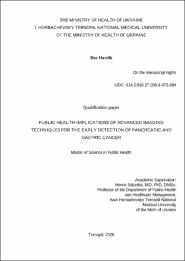
PUBLIC HEALTH IMPLICATIONS OF ADVANCED IMAGING TECHNIQUES FOR THE EARLY DETECTION OF PANCREATIC AND GASTRIC CANCER
| dc.contributor.author | Hardik, Har | |
| dc.date.accessioned | 2026-06-30T10:50:53Z | |
| dc.date.available | 2026-06-30T10:50:53Z | |
| dc.date.issued | 2026 | |
| dc.identifier.uri | https://repository.tdmu.edu.ua//handle/123456789/29757 | |
| dc.description.abstract | Pancreatic and gastric cancers represent significant public health challenges worldwide due to their high mortality rates, substantial healthcare costs, and frequent diagnosis at advanced stages. Early detection remains one of the most effective approaches for improving patient outcomes, increasing survival rates, and reducing the overall burden of these malignancies. Advanced imaging technologies have emerged as important tools in cancer diagnostics, offering opportunities for earlier and more accurate detection, improved staging, and more effective treatment planning. The aim of this study was to investigate the public health implications of advanced imaging techniques for the early detection of pancreatic and gastric cancer, assess current challenges related to cancer prevention and diagnosis, and develop recommendations for improving public health strategies in cancer control. The study employed a cross-sectional design and included 419 participants: 384 patients with pancreatic and gastric cancer registered at a regional oncological center, 23 radiologists and oncologists, and 12 public health specialists from regional centers for disease control and prevention. Data were collected through structured questionnaires and analyzed using descriptive and comparative statistical methods. In addition, a comprehensive review of contemporary scientific literature was conducted to examine current evidence regarding epidemiology, risk factors, diagnostic challenges, advanced imaging technologies, and public health approaches to cancer prevention and early detection. The literature review confirmed that pancreatic and gastric cancers continue to impose a substantial burden on healthcare systems and societies worldwide. Major risk factors identified included tobacco use, alcohol consumption, obesity, unhealthy dietary habits, Helicobacter pylori infection, chronic inflammatory conditions, genetic predisposition, and environmental exposures. The review also highlighted the importance of early diagnosis and the growing role of advanced imaging technologies such as computed tomography (CT), magnetic resonance imaging (MRI), endoscopic ultrasound (EUS), positron emission tomography-computed tomography (PET/CT), and advanced endoscopic techniques in cancer detection and management. The study findings demonstrated that delayed diagnosis remains a significant problem. Patients identified limited awareness of early cancer symptoms, difficulties accessing specialist services, and prolonged waiting times for diagnostic examinations as major barriers to timely diagnosis. Physicians emphasized insufficient availability of advanced imaging technologies, delays in referral pathways, and the absence of organized screening programs for many high-risk groups. Public health specialists highlighted challenges related to funding, healthcare infrastructure, and public awareness initiatives. Based on the findings, several recommendations were developed to strengthen public health strategies for pancreatic and gastric cancer prevention and early detection. | uk |
| dc.publisher | Ternopil | uk |
| dc.subject | pancreatic cancer | uk |
| dc.subject | gastric cancer | uk |
| dc.subject | public health | uk |
| dc.subject | early detection | uk |
| dc.subject | advanced imaging techniques | uk |
| dc.subject | computed tomography | uk |
| dc.subject | magnetic resonance imaging | uk |
| dc.subject | endoscopic ultrasound | uk |
| dc.subject | cancer prevention | uk |
| dc.subject | screening | uk |
| dc.subject | healthcare accessibility | uk |
| dc.subject | oncology | uk |
| dc.subject | cancer control | uk |
| dc.subject | public health strategies | uk |
| dc.title | PUBLIC HEALTH IMPLICATIONS OF ADVANCED IMAGING TECHNIQUES FOR THE EARLY DETECTION OF PANCREATIC AND GASTRIC CANCER | uk |
| dc.title.alternative | Master's Thesis | uk |
| dc.type | Thesis | uk |
Files in this item
This item appears in the following Collection(s)
Related items
Showing items related by title, author, creator and subject.
-
NURSING AND MODERN SURGICAL TREATMENTS FOR ONCOLOGICAL DISEASES
(Тернопіль, 2024)Nurses play an important role in preparation for and providing surgical treatments to cancer patients through their participation in all stages of the process, from preoperative preparation to postoperative rehabilitation. ...